How a centrifugal juicer works
A flat disc with a sharp cutting surface spins at high speed in the base of the machine. Produce pushed against it is shredded. The pulp is flung outward into a mesh basket, spinning force pushes the juice through the mesh, and the pulp stays inside or is ejected into a bin. The whole process takes seconds per piece, which is why sessions are short.
Breville's pages describe their approach as Cold Spin Technology: a stainless steel cutting disc inside an Italian-made mesh filter, with a claim of less than 1.8°F temperature transfer that Breville says comes from independent lab tests it commissioned. We report the claim as Breville's and cannot confirm it. We also classify these machines as centrifugal ourselves, because Breville's pages do not use the word.
Confirmed Breville models, side by side
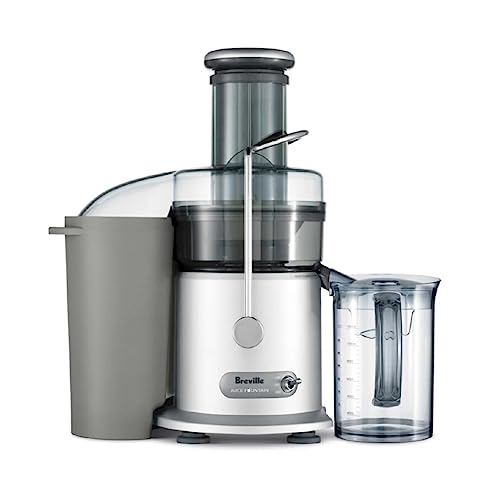
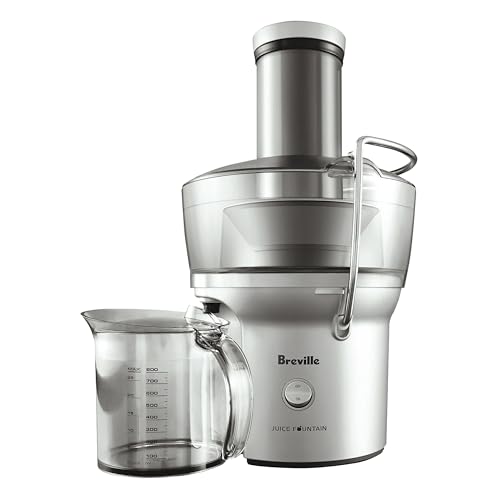
Three Breville Juice Fountain models have pages we could read. The difference is mostly power, jug size and chute.
Confirmed models only, read from each maker's own page on 2026-11-14. Blank cells say "not stated".| Model | Type | Speed | Power | Feed chute | Parts that touch food | Noise | Warranty |
|---|
Juice Fountain Compact (BJE200)
Breville | Centrifugal (our classification: cutting disc and mesh filter; maker does not use the word) | not stated | 700 W | 3 in | not stated | not stated | 1 year limited (brand warranty) (source) |
|---|
Juice Fountain Cold (BJE430)
Breville | Centrifugal (our classification: cutting disc and mesh filter; maker calls it Cold Spin) | not stated | 850 W | 3 to 3.5 in (the page gives 3 in in one place and 3.5 in in another) | not stated | not stated | 1 year limited (brand warranty; in the page's product data, not the visible spec table) (source) |
|---|
Juice Fountain Cold Plus (BJE530)
Breville | Centrifugal (our classification: cutting disc and mesh filter; maker calls it Cold Spin) | not stated | 1000 W | 3.5 in | not stated | not stated | 1 year limited (brand warranty) (source) |
|---|
Spec-check log: every value above is in docs/spec-log.csv with its source. Models we could not read on the maker's page are left out, not guessed. Prices are not shown because they change daily.
The BJE200 Compact is single speed (on and off) at 700 W with a 25 oz juice jug and a 1.6 qt pulp container; its chute is 3 in. The BJE430 Cold is two-speed at 850 W with a 70 oz jug, and its chute is stated as both 3 in and 3.5 in on one page. The BJE530 Cold Plus is two-speed at 1000 W, with a 70 fl oz jug and a 3.5 in chute, and is the heaviest at 13.6 lb. All three carry a 1-year limited warranty on Breville's pages. RPM, parts counts and noise are not stated for any of them.
The reason to buy one: the chute
A 3 to 3.5 in chute takes a whole apple, a whole beet and a thick carrot with little or no cutting. That is the main practical advantage over most slow juicers, whose chutes are often narrower. If your mornings are tight, minutes saved on chopping matter more than a spec the maker does not publish anyway. The trade-off is that leafy greens, herbs and wheatgrass tend to be pushed past the disc instead of crushed, so they are better served by a slow juicer; see centrifugal juicers for hard vegetables for what they do well.
Foam, oxidation and drinking soon
Fast juicers add air, so juice from them often has a layer of foam. Breville's jugs include a froth separator for that reason. Juice also changes colour and taste as it sits in contact with air, which is one reason to drink it soon. Our oxidation explainer covers what is known and what makers claim. For any home juice, the storage rule is the same: no official time exists for unpasteurized juice, so drink it soon and follow the storage chart.
Cleaning and noise
Fast juicers have a basket and a filter that need a brush to clear pulp from the mesh. A brush comes in the box with the Breville models we read. Noise is the main drawback people report: motors of 700 W to 1000 W run loudly for the minute or two a session lasts. Breville gives no decibel figure on these pages, so we do not rate noise. Read our mesh screen guide for cleaning technique.
Yield and pulp: what to expect, and what we do not claim
Fast juicers leave wetter pulp than slow juicers, and many people run the pulp through a second time or add it to soups and baking. We do not give a percentage difference in yield, because we have not measured it and makers' own claims are not independent. Breville's page for the BJE200 claims up to 30% more juice and 40% more vitamins and minerals than other juicers; we cannot verify that and do not use it to rank anything. If juice yield is your main goal, use the juice planner, which shows an editable yield estimate per item from a single published table, and treat any figure as approximate.
A realistic session
Wash produce, trim ends, and feed it in with the pusher at a steady pace. Alternate hard and soft produce: a handful of spinach pressed between two pieces of apple or carrot gets more out of a fast juicer than leaves on their own. Our basic green juice uses cucumber, celery, spinach, apple, lemon and ginger and suits this approach. Pour, froth-skim if you like, drink soon, and rinse the basket straight away before pulp dries on the mesh.
Which of our recipes suit a fast juicer
A fast juicer is strongest on firm produce such as cucumber, celery, carrot, apple and beet. The table sorts our juicer recipes by how much of each is firm produce, using the ingredient weights in our recipe data. Recipes with a high leafy share are better suited to a slow juicer, or need leaves fed between firm pieces.
Notice how few recipes need a wide chute for leaves: most of the weight is cucumber and apple, which the Breville models' 3 to 3.5 in chutes take in large pieces.
Decide in three questions
- How many minutes do you have? A wider chute means less cutting. Breville lists 3 in for the BJE200, 3 to 3.5 in for the BJE430 and 3.5 in for the BJE530.
- How big is the jug? Jugs are 25 oz to 70 oz on the Breville pages. One of our single-serving recipes yields 9 to 14 fl oz, so a 25 oz jug is enough for one person.
- Where will it live? The BJE430 is listed at 13.6 x 8 x 16.7 in; measure the shelf, not only the counter.
Category picks
- Compact single-speed juicer. For occasional juicing and small kitchens; check the jug size, because a small jug means pouring between glasses.
- Two-speed wide-chute juicer. A softer setting for leafy or soft fruit, a faster one for hard produce.
- Large-jug juicer. For juicing for a household in one go; check the pulp container so you do not stop to empty it.
The cards below link to Amazon searches for these types.
Good for a beginner?
Often yes, because the machine is forgiving: drop produce in and press. Our beginner guide lists what to watch for, mainly noise and how much produce leafy greens consume. If you want to know whether you will keep juicing before spending more, a fast juicer is a sensible first machine; if you already know you will juice greens daily, see the masticating hub.
Who each choice is for
Short on time
A wide chute and quick sessions beat chopping. Whole produce goes in.
Hard-vegetable juicers
Carrots, beets and apples are what the design handles best.
Occasional juicers
The lower power Compact model is the lightest and simplest.
Questions this page answers
Do Breville Juice Fountain models list an RPM?
Not on the pages we read. We show 'not stated' rather than guessing.
Which Breville has the widest chute?
The BJE530 is listed at 3.5 in. The BJE430 page gives 3 in and 3.5 in in different places; the BJE200 is listed at 3 in.
Is centrifugal juice worse?
We make no such claim. The designs differ in speed, noise, chute width and how they handle greens; claims about nutrients come from makers and are untested here.
How much juice does one of our recipes make in a fast juicer?
Our recipe pages give an estimate from published tables, for example about 9 fl oz for celery juice and at least 14 fl oz for the basic green juice. Real yield varies with the machine and the produce.
Sources: Breville BJE200; Breville BJE430; Breville BJE530.
General buying information, not medical or nutrition advice. We have not tested these products hands-on; specs come from the maker pages named above. See how we choose.